
Why Neighbour Bets in Roulette Can Offer a Better Experience (But Not Better Odds)
Neighbour bets remain a long-standing favourite among roulette enthusiasts who appreciate structure, rhythm and strategic control. While these bets do not alter the mathematical edge of the game, they shape a style of play that feels more deliberate and consistent. By focusing on clusters of adjacent numbers on the wheel, players create a more coherent betting pattern that can contribute to a clearer understanding of outcomes and a more engaging approach to decision-making. This article explains why neighbour bets improve the overall experience without giving any statistical advantage.
The Structure Behind Neighbour Bets
Neighbour bets revolve around a simple idea: wagering on a central number and its surrounding numbers on the wheel layout. Instead of spreading chips chaotically, the player engages with a structured system where every wager has a purpose, forming a compact zone of interest. This makes each spin more meaningful, as the player follows a tighter group of numbers rather than an overly wide field.
The physical arrangement of numbers on a roulette wheel is intentionally non-sequential, designed to balance high and low, red and black, and odd and even numbers. Neighbour bets take advantage of this arrangement by allowing the player to focus on small wheel segments rather than chasing numerical patterns on the felt. This offers a more grounded overview of how spins align with the wheel rather than the table grid.
For many players, this structured approach reduces the feeling of randomness. Although the probability remains the same, tracking a defined cluster provides a clearer mental framework. It transforms each round from a series of independent guesses into a more coherent sequence of observations.
Why Structure Improves Player Engagement
One key reason neighbour bets feel more engaging is the reduced chaos in decision-making. Players who rely on instinctive or impulsive bets often find themselves placing chips everywhere without a clear plan. Neighbour bets, on the other hand, naturally create consistency, which many players find more satisfying and easier to analyse over time.
Structured betting also supports emotional control. Instead of reacting to short-term outcomes, the player follows a long-term pattern centred on a specific wheel segment. This approach fosters patience and helps avoid common pitfalls such as random chasing or sudden reversals in betting behaviour.
Finally, neighbour bets strengthen the player’s connection to the wheel itself. Observing repeated interactions between the ball and the chosen wheel segment creates a sense of familiarity. While this does not affect probability, it enhances the overall enjoyment and gives players a feeling of continuity across spins.
The Limits: No Effect on House Edge
Although neighbour bets enhance the playing experience, they do not improve the underlying odds. Roulette remains governed by fixed probabilities, with the house edge remaining constant regardless of betting patterns. The ball has no memory, and wheel segments do not gain any extra likelihood simply because a player focuses on them.
The structure of neighbour bets may give the impression of predictability, but this is a psychological effect rather than a statistical change. The wheel’s random nature means that even well-organised betting zones cannot bypass the built-in advantage of the zero or double zero, depending on the game version.
Some players mistakenly assume that tracking wheel sections can indicate “hot” or “cold” areas. However, modern roulette wheels are engineered for consistent rotation and balanced distribution. Any patterns observed over a short period occur purely by coincidence rather than bias.
Understanding the Statistical Reality
Every number on the wheel has an identical probability of appearing on any given spin. Betting on five adjacent numbers as a neighbour bet simply means covering five numbers, not increasing the chance of the ball favouring that section. The probability is strictly tied to how many numbers are covered, not where those numbers sit on the wheel.
The house edge in European roulette stands at 2.70%, and in American roulette at 5.26%. These values apply uniformly across all types of bets, including neighbour bets. This means there is no strategic benefit in terms of expected value, no matter how refined or consistent the betting pattern appears.
Players who enjoy neighbour bets should therefore view them as a stylistic preference rather than a method for improving long-term results. The pleasure comes from engagement and structure, not from altering the underlying mathematics of the game.
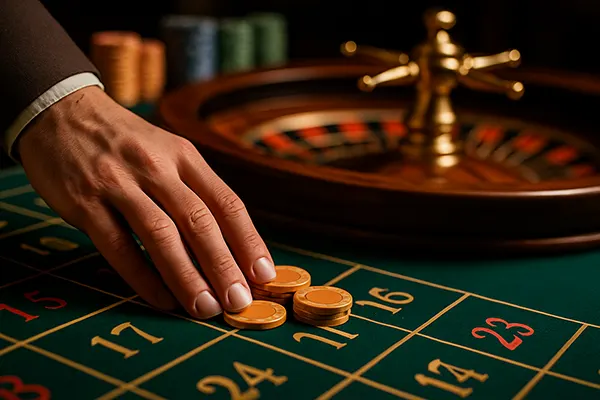
Why Neighbour Bets Enhance the Playing Process
Neighbour bets create a clear focal point, which can help players follow the game with greater interest. Instead of scattering attention across the entire wheel, the player becomes invested in a specific zone, following its performance with each spin. This type of focus contributes to a more immersive process.
These bets also encourage discipline. A player committed to a specific wheel segment tends to stay consistent rather than making impulsive changes. This sense of discipline is valuable both for emotional balance and for maintaining a long-term betting pattern that feels satisfying and controlled.
Finally, neighbour bets offer a smoother pace of play. By selecting a cluster of numbers each round, players avoid the hurried decision-making that often accompanies rapid changes in strategy. This slower, more measured rhythm helps maintain clarity and reduces stress during extended sessions.
The Psychological Benefit of Predictable Patterns
Humans naturally respond to patterns, even in games of chance. Neighbour bets provide a stable pattern that can make the game feel easier to follow. While randomness remains untouched, this sense of familiarity helps players remain calm and observant.
Predictable betting behaviour does not change outcomes but improves the player’s relationship with the game. Instead of feeling overwhelmed by constant variability, the player follows a system with defined boundaries, which can be mentally reassuring.
In practical terms, this means that neighbour bets serve as a bridge between players and the fast-moving nature of roulette. They provide structure without illusion, engagement without misplaced confidence, and a way to enjoy the game by focusing on process rather than results.